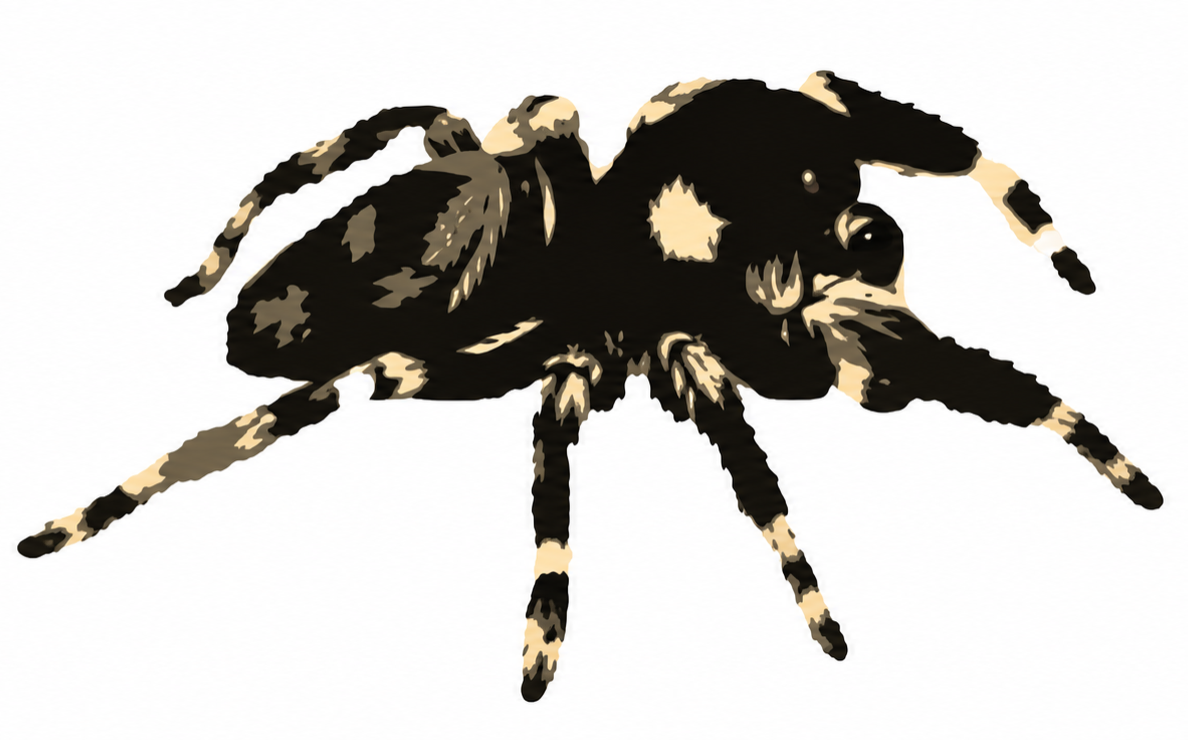
We received some jumpers from Arizona back in October, 2015. We're happy to say that progress is being made with some of those jumpers. We are currently rearing Phidippus octopunctatus spiderlings. They are mostly 3rd instars at the moment. We're hoping that they'll grow well this spring and become beautiful gray jumpers by summer.
We also have two sacs of 1st instar P. apacheanus spiderlings. These adult females are a yellowish-tan color. We're hoping that these will be aggressive feeders and be available by early to mid-summer.
The most interesting jumper that we received is the extremely rare Phidippus tux. We currently have four immature jumpers that we've been rearing. These are gorgeous jumpers related to Phidippus cardinalis. We're hoping that they'll mature in the next couple of months and we have at least one male and female. We can only hope at this moment that we end up with some spiderlings. We'll keep you posted.
The gorgeous images at the top of this post are of two P. tux juveniles taken by our friend Andres Moline. You can see more of his work on his Flickr page at:
We are pleased to announce the Phidippus apacheanus from Central Florida are finally available for purchase. These are unsexed juveniles at least 6mm in body length. They are large enough to eat 1/4" crickets and houseflies. They are all very similar in appearance and are all red to red-orange in color. Some of these will become orange as they mature, but it's impossible to know which will be orange and which will be red as adults. Shipping will begin Monday, July 13th.
Florida P. otiosus and P. regius-otiosus hybrids
· 3 Comments
The Florida P. otiosus and P. regius-otiosus hybrids are now available. There is a great deal of variation among these hybrid jumpers. Your jumper may not necessarily look like this male pictured, but we do have a fair number of young males that are very similar to this adult male. The females are often lighter in color than the males such as in P. regius.
We currently have some spiderlings that are 6th instar, which is a good size juvenile that can easily take small crickets. Our Florida P. apacheanus are still mostly 4th instar, which is too young to make them available here on the website. If you have an interest in purchasing these before we make them available, you may contact us. They are quite aggressive and easy to raise if you have access to fruit flies or pinhead crickets.
Spiderling Update
· 6 Comments
The newest available jumper is P. regius dark form females. These jumpers will be black and white in color. It can be challenging to differentiate young females from the males. These are not the only P. regius that we have in stock however. We are also rearing the orange form, but they are still too young to make available.
We also have Florida P. otiosus and P. regius x P. otiosus hybrid spiderlings that we are rearing. These are offspring of one our orange form female P. regius and a Central Florida male P. otiosus. The hybrids should be available in March or April.
Our P. mystaceus spiderlings are amazing little jumpers. They are currently 4th and 5th instars, and I'm considering making them available very soon. They will need small crickets or fruit flies for food. We are also rearing the Florida P. apacheanus, P. audax, P. putnami, and P. purpuratus. The P. audax and P. purpuratus are available for purchase. The P. apacheanus and P. putnami are not yet available. They will likely be available in May.
Thanks to all of you who have been supporting our effort to make these jumpers available to all who love these awesome little creatures.
Phidippus apacheanus Update
· 4 Comments
In October of this year, we received four wild-caught adult female Phidippus apacheanus females from our friend Martin Fisher. These gorgeous females are all from Central Florida. The females that I had collected in Missouri last year all overwintered for a few months before making egg sacs. I was curious as to whether these females would overwinter or make egg sacs as soon as they fattened up. I'm pleased to say that all four females have made egg sacs, and we now have second instar P. apacheanus spiderlings. The spiderlings have not yet left the sacs, but it won't be long. We can expect these spiderlings to be available in April, 2015.
I'd like to state once again that once we acquire a species or variation of a particular species, we no longer have a need to take those jumpers from the wild. All of our spiders that are for sale here on the site are raised in captivity from the egg. This minimizes the effect on the environment.
The Red Velvet Jumper - Phidippus apacheanus
· 1 Comment
This beautiful species is one that matures in the fall. The adults mate and the females then fatten up and overwinter in their sacs. The females that I collected as adults in Missouri in the fall of last year spent a few months in thick sacs, then began to come out in January since they were indoors. The first egg sac was made in late January of this year. I currently have a few of their offspring that are doing this, and they are in sunny South Florida.
While this is a beautiful species, I found that these females that I raised in captivity are on the small side, with body lengths ranging from 8mm to 11mm. Also, by making overwinter sacs shortly after maturing, this is not ideal behavior for a pet jumping spider. In our continuing effort to bring the largest and most colorful species of jumping spiders to the public, we are pleased to announce that we will be offering apaches from Central Florida next spring. These jumpers are larger and more colorful than the variation from Missouri. Since these are a warm climate variation, I do not expect long-term overwintering.
A special thanks goes out to Patrick Zephyr, Martin Fisher, and Ryan DeLuca. Without photographer friends like them, we wouldn't be able to bring you such spectacular images of our jumpers.
The uncommon Phidippus pius
· 2 Comments
We are pleased to announce that we will be offering Phidippus pius in the spring. This is a widespread but uncommon species found from throughout the eastern U.S. to the southwest. The abdominal colors of females can range from light tan to yellow to orange, depending on which region of the country they are found. The males can range from light orange to red. They mature in the summer and make their egg sacs in the fall. The females of this species are very calm and can be handled with ease.
Florida Phidippus otiosus
· 0 Comments
This beautiful girl is one of our newest jumpers. She's an adult P. otiosus from Central Florida and is the size of a typical P. regius. She'll be responsible for providing the next generation of Phidippus otiosus spiderlings. We began this site earlier in the year with a very limited inventory. Our first generation of P. otiosus were a typical non-Florida variety. These are smaller and generally less colorful than what we find in Florida. Next spring, you can expect these beautiful jumpers to be available here on the site.
We understand people's concerns about collecting animals from the wild. We believe in protecting and preserving our natural areas and native plants and animals. This is why once we collect our first jumpers of a particular species or color form, we will never have to do this again. This has minimal effect on the populations. Many of our spiderlings are released back into natural areas where they are found. We can not possibly rear all of the spiderlings that are produced by our females. With that being said, thank you to all who have been supporting our effort to make jumping spiders a family-friendly pet option.
Phidippus audax maturing
· 0 Comments
Our Big Bend P. audax are growing and maturing. We currently have five individuals that are subadult bryantae variations, and three of them have fused spots. They are absolutely beautiful. We will be using these to create our next generation of P. audax. I've seen a very limited number of bryantae variations from my batches of spiderlings this year, but the next generation of them will be different. From past experience, when a pair of P. audax bryantae variations are bred, the offspring are almost entirely this form as well. So by early next year, I'll be offering P. audax bryantae variations as a color form of P. audax, and many of them will have fused spots. Also, these North Florida P. audax are larger than the average P. audax. The two males that I used for breeding with the current group of spiderlings were 14mm and 15mm in body length respectively. Those are large males.
Here are a few photos of David Hill's P. audax that I donated to him earlier in the year. You can see these photos and many more on David's Flickr page.
North Florida Phidippus audax
· 0 Comments
The bold jumper (Phidippus audax) is one of the most widely distributed species of jumping spiders across North America and is probably the most recognized Phidippus species. Individuals are typically black with white markings. As juveniles, individuals often have orange abdominal markings. As they mature, the color fades, becoming white with the last molt.
The Big Bend population of P. audax in North Florida contains the most variable individuals that you'll ever see. These individuals often retain their orange markings as adults and have beautiful bands across the back of their heads. When a P. audax has colored scales along the sides of its abdomen, it is said to be a bryantae variation. We're currently rearing some of these bryantaes, some of which have fused spots.
Hanging by a thread
· 1 Comment
The following post is a description by Dr. David E. Hill of Phidippus putnami behavior followed by images of what he observed.
"On July 17th, I photographed the mating of a pair of P. putnami (male from Seminole County, Oklahoma, female from Greenville County, South Carolina): At that time the male approached the female with his usual display and courtship, and quickly mounted and mated on the left side for about 30 minutes. I don't think the female had time to consider the subtle details of his display, as he advanced and mounted directly. On subsequent days, I placed the male with the female and photographed his display, but each time she stalked him actively and I ultimately intervened. She then would quickly capture whatever insect I gave her, a level of hunger often observed in mated Phidippus.
Four days later (July 21) I fed her a large planthopper first, then introduced the male to the plant she was on at a distance of about 20 cm. When the male saw her this time, he watched her for about a minute, then crouched low and ran quickly to a distance of several cm, when he jumped over her prey and grabbed her. Startled, she immediately jumped off of the leaf but he held on. They proceeded to mate while suspended from the female's dragline for about 30 minutes, this time exclusively on the right side. The female clung to the prey in her chelicerae at this time, and did not struggle to escape: When the male finished and removed his pedipalp, he jumped down to the ground, and the female lowered herself (rappelled) down to the ground, still holding her prey. An hour later, she was still feeding on it. I have seen similar behavior in P. pius and P. clarus before.
Many studies of salticid courtship create the impression that a male must please the female with a series of audio and visual displays before she will mate, but from my experience many males, even one as ornate as P. putnami, don't display more than they need to. In this example, the following are possible:
1. A male may be able to determine that a female has mated on one side, and will then preferably mate on the other side.
2. A male may directly take physical control of a female when he observes that she is feeding and occupied with large prey.
Cheers!
David"
Our latest species that was made available for sale is the Phidippus otiosus. These spiderlings are offspring from two Montgomery, AL females. Many of these spiderlings have three markings on the tops of their heads. These are called carapace markings. It's been a general rule among the jumping spider experts that if you see three markings on the top of the carapace, then the Phidippus species is P. mystaceus. After consulting with Dr. G.B. Edwards, we've come to the conclusion that the northern populations of P. otiosus sometimes have these markings similar to P. mystaceus. Here is a photo of one of the spiderlings taken by Dr. David E. Hill.